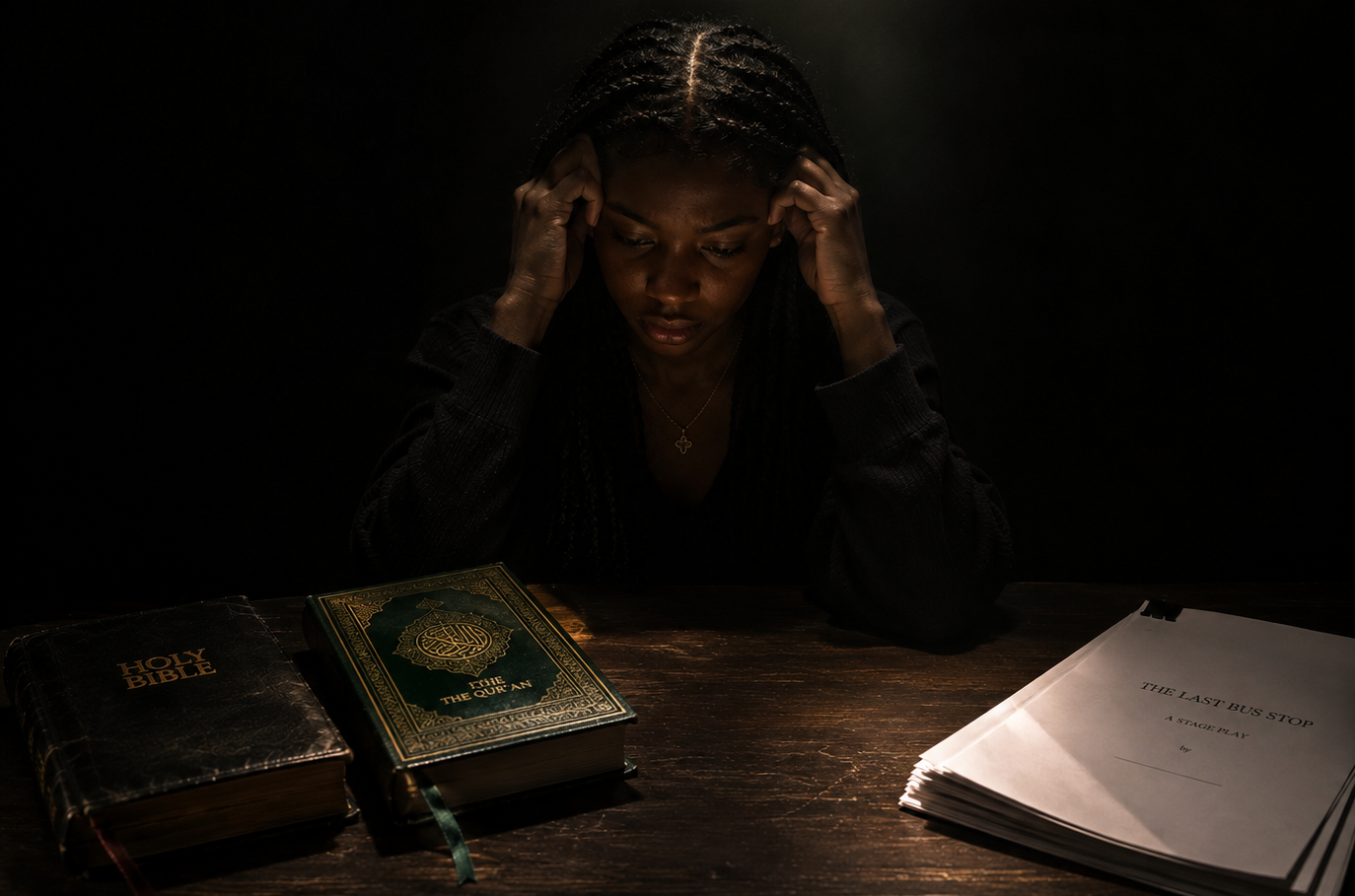
Must an Artist choose between Faith and Creativity?
Imagine telling someone you study Theatre Arts only for them to ask “But you still go to church right?”
Funny? Perhaps. But for some of us in the creative industry, the relationship between religion and our chosen profession is a conversation we cannot seem to escape.
Some believe the entertainment industry is ungodly. Others argue that acting particularly when it involves revealing costumes, smoking scenes or morally questionable characters, contradicts religious values and for those of us who love both our faith and craft, this raises an uncomfortable question: Must we choose between God and the thing we love?
Let's talk about it.
THE CHARACTER IS NOT THE ACTOR
An actress plays a woman who smokes in a film. Suddenly people are questioning her relationship with God. An actor portrays a criminal and some viewers begin to associate him with the character he plays.
But when did portraying a character become the same as endorsing their behaviour?
An actor can play a villain without being one. A Christian can portray someone who rejects religion without rejecting their own faith. A performer can tell a story about immorality without promoting it.
That is part of what storytelling does. It allows us to explore lives, decisions and experiences beyond our own.
Of course not every production communicates its message responsibly. Art deserves criticism when it promotes harmful ideas but there is a difference between questioning what a film represents and assuming that everyone involved personally believes in everything depicted.
If actors could only portray people whose lives reflected their own values, how many stories would we be left with?
IS THE ENTIRE INDUSTRY UNGODLY?
The entertainment industry has its problems. Nobody needs to pretend otherwise but does that mean everyone working in it has abandoned their morals?
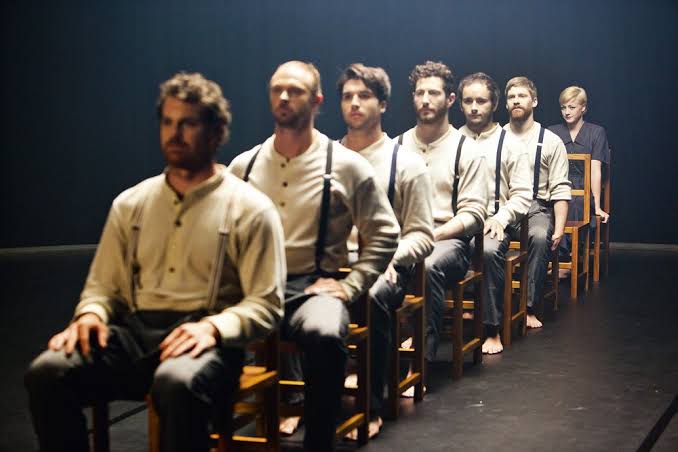
Theatre is more than revealing costumes, controversial performances and celebrity lifestyles. It includes children's theatre, educational drama, cultural performances, historical plays and productions that challenge corruption, injustice and social problems.
Interestingly, religious stories have also inspired dramatic performances for centuries. Theatre can explore faith, morality and spirituality just as it can examine love, betrayal, grief and human weakness.
So why do we sometimes treat theatre as an enemy of religion?
Perhaps the problem is not the art form itself but how people choose to use it.
WHEN FAITH MEETS THE COSTUME
Now let's consider something more complicated.
A Christian actress receives a role but the costume makes her uncomfortable because of her religious convictions.
Or a Muslim actress is asked to portray a woman who does not wear a head covering.
What happens next?
Should the actress compromise her beliefs for her career? Should the director change the character? Or should she decline the role?
These situations do not always have easy answers. Religious convictions deserve respect, but so does the creative process.
A costume may communicate something important about a character. At the same time, an actress should be able to express her boundaries without being labelled unprofessional or accused of lacking commitment.
The same applies to religious representation. Muslim women, like Christian women, have diverse experiences and practices. A character's appearance should be considered in the context of the story rather than reduced to assumptions about an entire religious community.
Sometimes, a conversation can produce a compromise. Sometimes, the actress may decide the role is not for her.
Both are possibilities.
But must a disagreement about a costume become a judgement about someone's relationship with God?
SO, MUST WE CHOOSE?
I think this is where the conversation becomes personal.
What happens when you genuinely love God but also dream of becoming an actor, playwright or director? What happens when the very thing that makes you feel creatively alive is the thing someone tells you to abandon?
Must you constantly prove that you are still religious? Must your career choice automatically becomes evidence against your faith?
I don't believe these questions have one answer for everyone. Artists have different convictions and some roles will genuinely conflict with their beliefs. Nobody should be forced to abandon their boundaries in the name of professionalism.
But there is a difference between deciding that a particular role is not for you and declaring that an entire profession is incompatible with your faith.
An artist should be able to make thoughtful decisions about their work without being condemned simply for choosing the creative industry.
Perhaps the conversation should focus less on whether theatre is inherently ungodly and more on the stories we tell, the messages we communicate and the values we bring into our work.
After all, an actor's profession cannot tell us everything about his character, just as a character's actions cannot tell us everything about the actor.
THE FINAL QUESTION
Perhaps, the most important question is: Must someone abandon the gift of storytelling to prove the sincerity of their faith?
Theatre allows us to question society, explore human behaviour and tell stories that make people think. Sometimes, those stories will challenge our beliefs. Sometimes, they will reinforce them and sometimes, they will leave us with uncomfortable questions that have no immediate answers.
That is the power of storytelling.
We should be able to criticise a production without condemning everyone involved. We should be able to respect religious convictions without assuming that every artist has abandoned theirs.
Perhaps faith and creativity will not always agree. Perhaps some decisions will require difficult compromises but that does not mean every artist must choose one and surrender the other.
Maybe the real question isn't whether God can exist in theatre. Maybe it's why we are so quick to assume He cannot!